

7 Days Summit Hiking to Margherita Peak: A Detailed and Authentic Mountain Journey
A 7 days hike to Margherita Peak is more than a mountain climb. It is a journey through changing vegetation zones, river valleys, and high alpine landscapes. Margherita Peak rises to 5,109 meters in the legendary Rwenzori Mountains. The range lies within Rwenzori Mountains National Park in western Uganda.
This 7 days trekking to Margherita Peak follows the Central Circuit. The route allows gradual acclimatization while exposing hikers to rainforest, bamboo forest, heather zone, and Afro-alpine vegetation. The trail crosses rivers like Mubuku and Bujuku, climbs steep ridges, and passes through scenic valleys.
The slow pace improves safety and comfort. Each day introduces new plant species, birds, and mountain views. From montane forest to glaciers, the experience remains diverse and rewarding. Below is a detailed day-by-day account based on real trekking experience in the Rwenzori Mountains.
 Day 1: Nyakalengija (1615m) to Nyabitaba Camp (2651m)-Montane Forest Zone.
Your day on the Mount Rwenzori adventure begins with an early breakfast before transfer to the offices of Rwenzori Mountaineering Services for a detailed briefing. You meet your mountain guides and chefs, review safety procedures, and sign rescue forms. A short drive then takes you to Mihunga Gate, the main entry to Rwenzori Mountains National Park.
At Mihunga Gate, you sign the park register and provide emergency contacts. The guide explains the Central Circuit route using the large map at the entrance. The hike begins right away through the lush montane forest zone. You cross the Mubuku River and its clear tributaries, River Kyoho and River Mahoma. The forest is dense with Macaranga, Faurea saligna, Symphonia globulifera, and Maesopsis eminii. Tall trees form a green canopy above the trail.
Wildlife sightings add life to the walk. You may spot black and white colobus monkeys, blue monkeys, and three horned chameleon moving quietly through the trees. Bird lovers often see the Rwenzori turaco, handsome francolin, and cinnamon chested bee-eater. After a steep climb, you rest at Panga Ridge for a packed lunch with scenic views. The trail continues uphill to Nyabitaba Camp, you can reach after 4 to 6 hours of hiking. Upon arrival rest, have dinner and overnight stay.
Accommodation: Nyabitaba hut.
Meal Plan: Full board.
Day 2: Nyabitaba Camp (2651m) to John Matte Camp (3380m) – Kurt Shafer Bridge, Bamboo, and Heather Zone.
Wake up early at Nyabitaba Camp and enjoy a warm breakfast before setting off for another exciting day in the Mount Rwenzori. The trail descends gently for about twenty minutes to the famous Kurt Shafer Bridge. From this wooden bridge, you witness the dramatic meeting point of River Bujuku from Margherita Valley and River Mubuku from Mount Baker. After the confluence, the waters continue as the Mubuku River. The view is wide, wild, and refreshing.
The hike proceeds through thick vegetation where Lobelia gibberoa grows at lower altitude. Blackberries, ferns, Solanum nigrum, and Dracaena afromontana line the path as you descend. Colobus monkeys leap through the trees while blue monkeys call from a distance. Birdlife is active and colorful. You may spot the Rwenzori turaco, olive pigeon, and strange weaver along the forest edge.
The bamboo forest zone soon surrounds you with tall green stems and moss covered trunks. Resting points at Omukomujunju and Nyamuleju allow time to regain strength. The 691 meter Nyamuleju boardwalk at 3,236 meters leads into the heather zone filled with Philippia trimera and Erica kingaensis. After 5 to 6 hours of hiking, you arrive at John Matte Camp for lunch, dinner, rest, and overnight stay inside Rwenzori Mountains National Park.
Accommodation: John Matte hut.
Meal Plan: Full board.
 Day 3: John Matte Camp (3380m) to Bujuku Camp (3962m) – Bigo Bogs and Valley Views.
After breakfast, you begin another exciting stage of your seven day hike toward Margherita Peak in the mighty Mount Rwenzori. The trail descends toward the Bujuku River and passes close to Bukurungu Trail. You carefully cross the lower Bigo Bog on raised wooden boardwalks. The wetland is rich with orchids, tussock grass, Giant Lobelia, and Giant Groundsel. Mount Gasi rises on the right side of the valley. Bright Helichrysum stuhlmannii, known as everlasting flowers, add color to the landscape.
At Bigo Hut, hikers can branch toward Mount Gasi or Mount Emin through Skull Cave. The main route climbs through rocky ground and thick heather roots before entering Upper Bigo Bog. Along the path you may see Lobelia bequaertii, Disa stairsii, and Lycopodium clavatum. Wildlife survives even in this harsh zone. Rwenzori rock hyrax rest among the rocks. Lammergeier, malachite sunbird, and Rwenzori double collared sunbird are sometimes seen in the afro-alpine air.
A 100 meter Bujuku River boardwalk leads to Omwihembe Resting Point. On a clear day, Margherita Peak and Alexandra Peak on Mount Stanley stand ahead. Mount Baker lies to the left while Mount Speke rises to the right. Heart shaped Lake Bujuku appears below the glaciers. After crossing the long 800 meter boardwalk at 3,897 meters, you reach Bujuku Camp for meals and overnight rest inside Rwenzori Mountains National Park.
Accommodation: Bujuku hut.
Meal Plan: Full board.
Day 4: Bujuku Camp (3962m) to Elena Camp (4500m) – the Afro-Alpine Zone.
Wake up early for breakfast before beginning the climb toward Elena Camp on the slopes of Mount Rwenzori. The trail moves through Afro alpine vegetation dominated by Dendrosenecio adnivalis and Lobelia wollastonii. The ground is swampy and often wrapped in cool mist. Carex tussocks and thick moss cover the soil. Bright Helichrysum flowers bring color to the high altitude landscape.
At Omukendege Resting Point, you reach the junction linking John Matte, Bujuku, and Kitandara routes inside Rwenzori Mountains National Park. The terrain soon becomes rocky with steep sections and metal ladders that assist climbers. Lake Bukurungu loops below near the Portal Peaks can be viewed from here. Wildlife still survives in this alpine zone. You may spot a red duiker moving quietly through shrubs. The Rwenzori rock hyrax hides among rocks. Bird species such as the alpine chat, bearded vulture, and scarlet tufted sunbird may glide across the valley.
After 3 to 4 hours of steady climbing, you arrive at Elena Camp. Savoia Peak and Philip Peak rise to the left. In the horizon, Mount Speke, Mount Baker, and Mount Stanley are prominent. Snow patches shine near the camp. You rest, enjoy lunch and dinner, and prepare carefully for the summit day ahead.
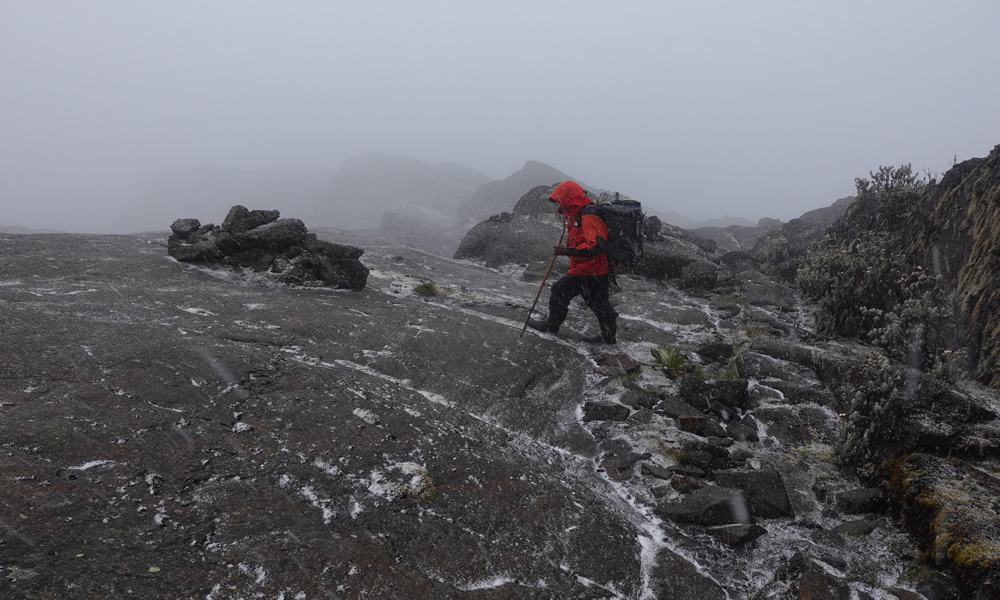 Accommodation: Elena hut.
Meal Plan: Full board.
Day 5: Summit Margherita Peak (5109m) and Descend to Kitandara Camp (4027m).
Summit day on Mount Rwenzori begins around 2:00 am or 3:00 am under a clear and freezing sky. After a light breakfast, you wear crampons and helmets before starting the ascent to Margherita Peak. The climb crosses glaciers and steep ice slopes with rope guided sections for safety. Ice formations shine brightly under headlamps as you move slowly upward using ice axes. The air feels thin and every step demands focus and strength. The Stanley Glacier lies beneath your boots while rocky sections require careful balance.
As dawn breaks over Mount Stanley, golden light spreads across the peaks. Reaching Margherita Peak brings deep joy and pride. Clouds settle below while Mount Speke and Mount Baker rise nearby against the morning sky. After photos and celebration, you descend carefully back to Elena Camp for a short rest and lunch inside Rwenzori Mountains National Park.
The journey continues down to Kitandara Camp through steep rocky slopes. Twin glacial lakes near Kitandara reflect cliffs and open sky. Wildlife survives even at high altitude. You may see the Rwenzori rock hyrax among rocks and spot the scarlet tufted sunbird or alpine chat flying across the valley. Lower altitude improves breathing as the body slowly regains strength. Dinner and overnight rest follow after this demanding summit day.
Accommodation: Kitandara hut.
Meal Plan: Full board.
Day 6: Kitandara Camp (4027m) to Guy Yeoman Camp (3450m) – Fresh Field Pass Crossing.
The morning begins with a warm breakfast at Kitandara Camp before starting the hike across Mount Rwenzori. The trail climbs slowly toward Fresh Field Pass. Wide views open across deep valleys, moss covered rocks, and distant ridges. The air feels fresh and crisp at this high point. The climb is steady and manageable after the joy of summit success. Patches of heather and low shrubs appear as the altitude reduces. The landscape slowly shifts from rocky afro alpine ground to mixed vegetation.
Wildlife becomes more visible along the descent. Small antelope such as the Rwenzori red duiker move quietly through shrubs. Birdlife is active in this zone. The Rwenzori turaco calls from the trees while the cinnamon chested bee-eater flashes bright colors in flight. Sunbirds feed on afro-alpine flowers near the trail.
From Fresh Field Pass, the route descends toward Guy Yeoman Camp inside Rwenzori Mountains National Park. Careful steps are needed on loose rock and damp soil. Clear streams flow gently beside the path. Guy Yeoman Camp sits at lower altitude with warmer temperatures. Upon arrival, you enjoy lunch, rest, dinner, and overnight stay as your body continues to recover.
Accommodation: Guy Yeoman hut.
Meal Plan: Full board.
Day 7: Guy Yeoman Camp (3450m) to Mihunga Gate to Nyakelenjiga (1615m).
The seventh day of your adventure on Rwenzori Mountain begins with an early breakfast at Guy Yeoman Camp. The journey back to Nyakalengija follows the Central Circuit trail downhill toward Nyabitaba Camp. The descent passes once again through heather, bamboo forest, and dense montane rainforest. Each vegetation zone reveals new detail when viewed on return. Clear streams cut through the valleys while moss covers rocks and tree trunks. Unique plants such as giant lobelia and tree heather stand tall along the path.
Wildlife activity increases as you lose altitude. You may observe black and white colobus monkeys leap between branches. Blue monkeys move quickly through the canopy. The Rwenzori turaco calls loudly from the forest while the handsome francolin crosses the trail. Small forest duikers hide in thick undergrowth. Passing Kichuchu, you continue toward Nyabitaba Camp for a well-earned lunch inside Rwenzori Mountains National Park.
The final stretch leads down forested slopes across River Kyoho and near Panga Ridge before reaching Mihunga Gate. At the gate, you receive a certificate for conquering Margherita Peak. Nyakalengija marks the end of this powerful seven day trek across diverse mountain ecosystems and dramatic landscapes.
A 7 days hike to Margherita Peak reveals rich rainforest biodiversity, tall bamboo forests, open heather zones, afro alpine landscapes, giant lobelias, glacier crossings, shining glacial lakes, and true summit achievement. The steady pace ensures safety, gradual acclimatization, and a deeply fulfilling mountain adventure experience.
Safari Highlight: End of Safari.
The package includes:
- Park entrance fees.
- Full board accommodation and meals while on the mountain.
- Porters and a chef to assist during the trek.
- Ice climbing equipment including harness, crampons, helmet, ice axe, ropes, and gumboots.
- English speaking guides.
- Ranger services.
- Rwenzori days of hike to Margherita Peak via the Central Circuit.
The package excludes:
- Air tickets and visa fees.
- Personal hiking gear and equipment.
- Tips for guides, porters, and chefs.
- Laundry services.
- All extra personal costs not specified in the package.