

Shoebill Tracking in Mabamba Swamp: Step Into the World of Uganda’s Giant Bird
Shoebill Tracking in Mabamba Swamp is an experience that turns an ordinary day near Lake Victoria into a memorable wildlife adventure. The journey is not about rushing from one point to another. It is about moving quietly through papyrus channels, watching the water, listening to birds calling from the reeds, and waiting for one of Uganda’s most unusual birds to reveal itself. Somewhere among the vegetation may be a shoebill, standing almost perfectly still as though it were part of the wetland itself.
Mabamba Bay, commonly known as Mabamba Swamp, is a large wetland on the shores of Lake Victoria and is well known among birdwatchers for its shoebill population. The area is also home to many other wetland species, giving visitors plenty to look for while exploring its waterways.
The real excitement comes from not knowing exactly when the bird will appear. You might spend several minutes studying a quiet stretch of papyrus before your guide points toward something in the distance. What looks like a grey stump suddenly becomes a bird with a huge bill and a powerful body.
That first sight can be surprisingly exciting. For travelers staying in or around Entebbe, Mabamba offers an opportunity to experience Uganda’s birdlife without traveling deep into the country. A canoe, an experienced local guide, binoculars, and a little patience are enough to begin the search.
 What Makes Mabamba Swamp Special for Birdwatching?
Mabamba is not simply a place where visitors go to see one particular bird. It is a living wetland made up of papyrus, shallow water, channels, open spaces, and areas of dense vegetation. These different habitats create suitable conditions for many birds and other wetland life.
The shoebill is undoubtedly the star attraction, but the surroundings make the entire trip interesting. While moving through the swamp, visitors can keep an eye out for African jacanas, herons, swamp flycatchers, African purple swamphens, African water rails, papyrus gonoleks, and other water-loving species.
This means that the search remains enjoyable even when the shoebill is temporarily out of sight. For example, a canoe may enter a narrow channel where the guide stops the boat and asks everyone to remain quiet. Instead of finding the main target immediately, you might notice a jacana stepping carefully over floating vegetation. A few moments later, a heron may lift from the edge of the water.
These smaller discoveries are part of what makes wetland birding enjoyable. Mabamba also provides a very different setting from Uganda’s savannah parks. There are no large safari vehicles moving across open grassland. Instead, the canoe follows natural waterways, allowing visitors to experience the wetland at a much slower pace.
Getting to Know the Shoebill
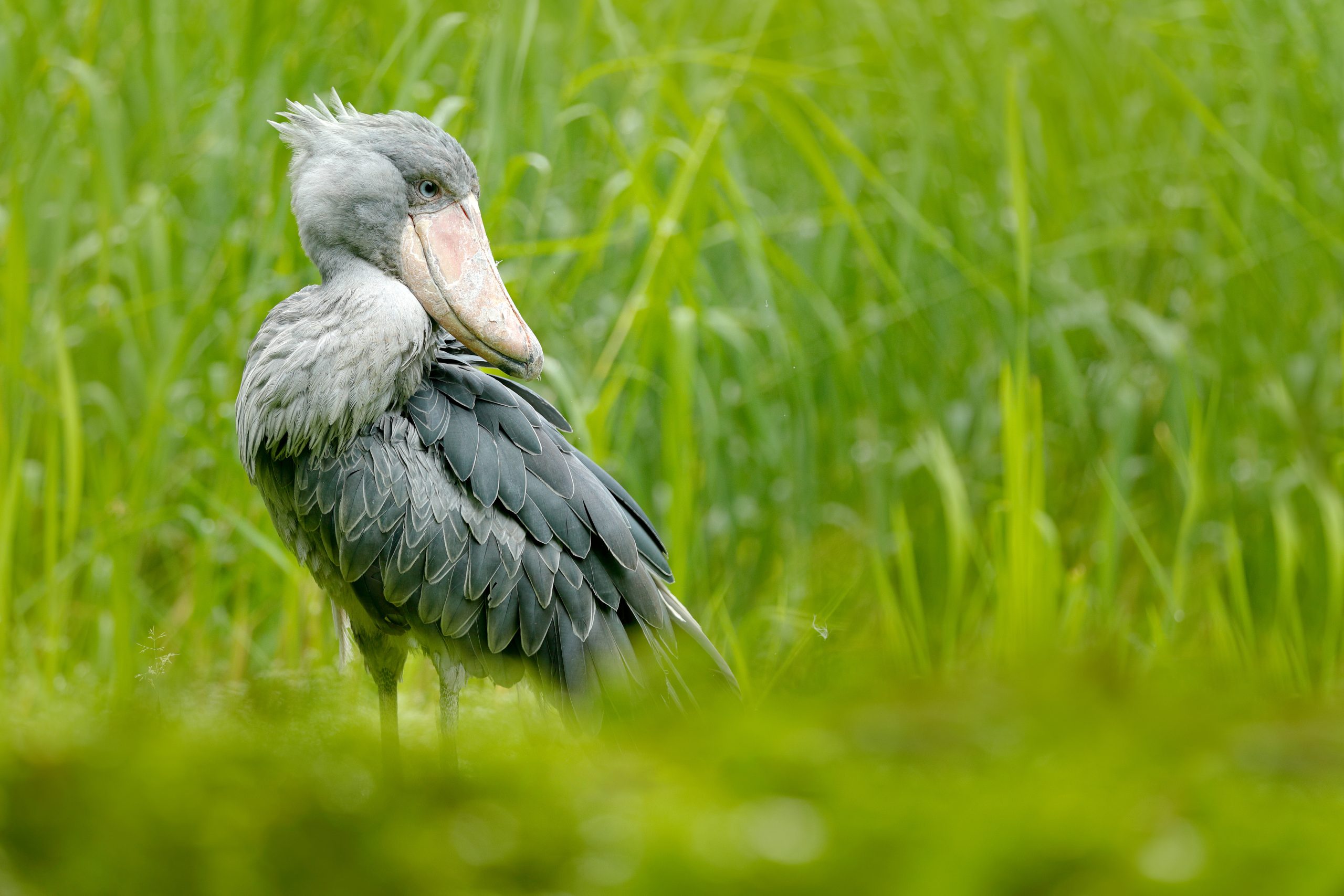
Before beginning the search, it helps to understand what makes the shoebill so unusual. Its most recognizable feature is its enormous bill, which has a broad shape that gives the bird its distinctive appearance. Its tall legs, large wings, grey body, and upright posture make it unlike most birds that visitors may have seen before.
One interesting thing about the shoebill is its stillness.
Many birds constantly move from one place to another, making them easy to notice. The shoebill can do the opposite. It may stand quietly for a long time while watching the water. From a distance, its body can easily be mistaken for a piece of vegetation.
This is why a guide’s experience can be important.
Imagine looking across a patch of reeds and seeing nothing unusual. Your guide studies the same area and points toward a grey shape. You look through your binoculars and slowly realize that the shape has a head, eyes, and an enormous bill.
The bird was there all along.
That moment explains why shoebill watching is more about patience than speed. The reward often comes after careful observation rather than a quick search.
Exploring the Wetland by Canoe
The canoe journey is one of the most enjoyable parts of a Mabamba visit. Rather than simply arriving at a viewing point and waiting, travelers enter the wetland and follow its narrow waterways.
The canoe moves gently across the water while the guide searches ahead. At certain points, the channel may open into a wider area. In other places, tall papyrus can close in around the boat, creating a peaceful corridor through the vegetation.
The slower pace gives visitors time to observe.
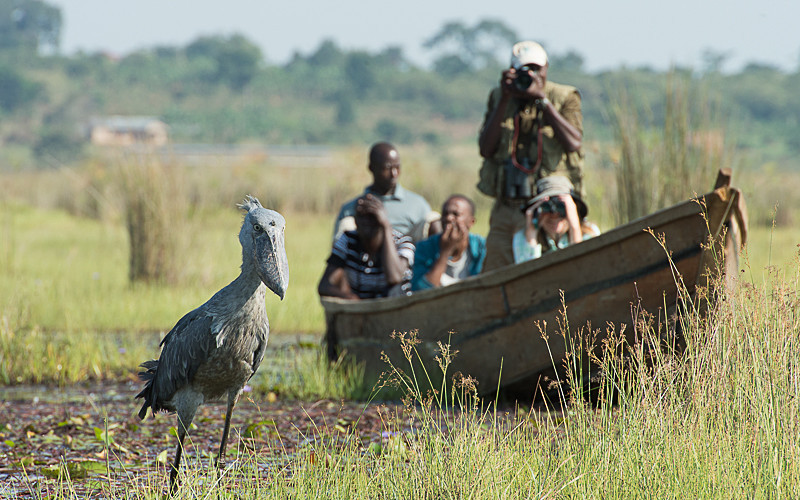
A guide may suddenly stop paddling after noticing movement along the edge of the channel. Everyone becomes quiet while the guide looks through the vegetation. Sometimes it is another bird. At other times, the search may lead to a shoebill.
This style of wildlife viewing can feel very different from a traditional game drive. There is no need to keep moving simply because the vehicle has reached a certain point. The canoe can remain still while everyone watches.
Visitors should also remember that conditions can vary. Water levels, weather, vegetation, and the location of birds can influence the experience. A wild shoebill does not follow a timetable, so sightings cannot be treated as guaranteed. That unpredictability is part of the adventure.
When Is a Good Time to Visit Mabamba?
Mabamba can be visited during different parts of the year, and Uganda’s birdlife makes the country attractive to birdwatchers across many seasons. Weather conditions can, however, affect travel and the general experience around the wetland.
The drier months (June to September and December to February) can be comfortable for many travelers because there is generally less rain. Uganda also receives migratory birds during parts of the year, adding another reason for bird enthusiasts to visit. However, there is no single date that guarantees a shoebill sighting.
The bird is wild and can move between different sections of the wetland. This means that the quality of the experience depends partly on patience and the skill of the guide rather than simply choosing one particular month.
The time of day can also influence the atmosphere. A quiet canoe ride when the wetland is calm can provide excellent opportunities to observe birds. Visitors should discuss the preferred timing with their local operator because weather, water conditions, and current bird activity can all affect the best schedule.
Rather than planning the trip around the promise of seeing a shoebill at an exact hour, it is better to allow enough time for proper exploration.
 Other Birds You May See Along the Way
One of the best things about a visit to Mabamba is that the search for the shoebill does not mean ignoring everything else.
The wetland contains many interesting birds, and your guide can help identify species that might otherwise pass unnoticed. Some birds remain close to the water while others move through the papyrus.
African jacanas are especially interesting to watch because they can move across floating vegetation with surprising ease. Herons may stand quietly near shallow areas, waiting for an opportunity to feed. Smaller wetland birds may appear briefly before disappearing into the reeds.
A visitor who arrives with only one target in mind may therefore leave with a much longer list of sightings. For example, you could begin the morning hoping to photograph a shoebill and end up spending several minutes watching a purple swamphen moving between plants. You may then hear another bird calling from the papyrus while a heron flies across the channel.
This variety gives Mabamba its own character. Birdwatchers should keep binoculars ready throughout the canoe trip rather than only using them when the guide announces a possible shoebill.
What Should You Carry for the Trip?
A little preparation can make a wetland excursion more comfortable. Binoculars are one of the most useful items because some birds may remain a considerable distance from the canoe.
If photography is important to you, a camera with a zoom lens can also be helpful. A long lens allows you to take photographs while maintaining a respectful distance from the birds.
Light and comfortable clothing is suitable for the excursion. Because you will be exposed to the weather, a hat, sunscreen, and drinking water are useful. Insect repellent can also be helpful, particularly around wetland vegetation.
A light rain jacket is worth carrying as well. Weather around Lake Victoria can change, and a short shower should not be allowed to ruin the experience.
Most importantly, bring patience. You may not see a shoebill immediately. You might spend time exploring several channels before your guide finds a promising area. Instead of viewing this as wasted time, use those minutes to enjoy the wetland itself.
Wildlife watching becomes much more rewarding when the journey is treated as part of the experience rather than merely a route to a photograph.
Why a Local Guide Is Important
A local guide can make a major difference during a Mabamba excursion. The wetland contains many channels and areas of vegetation that can appear similar to someone visiting for the first time.
An experienced guide is familiar with the waterways and understands how to move through them without unnecessarily disturbing birds.
Guides can also help visitors identify species. A beginner may see a bird disappear into the reeds without knowing what it was, while a knowledgeable guide may recognize its call or movement.
The same applies to shoebills.
A visitor may look toward an open patch of water and see nothing. The guide may scan the vegetation carefully, notice a familiar shape, and direct everyone to a particular point.
“Look just beyond that clump of papyrus.”
You raise your binoculars. Suddenly, the enormous bill becomes visible. Moments like this demonstrate the value of local knowledge. The guide is not simply steering the canoe. They are helping visitors understand how to read the wetland.
Mabamba as a Convenient Experience from Entebbe
Another advantage of visiting Mabamba is its accessibility for travelers staying in Entebbe. The wetland can be included in an itinerary without requiring a long safari journey to another part of Uganda.
This makes it particularly useful for travelers with limited time. For example, someone arriving in Uganda for a longer safari could spend time around Entebbe before continuing toward places such as Murchison Falls, Kibale, Queen Elizabeth, Bwindi, or other destinations. A visit to Mabamba can fit naturally into the beginning or end of such an itinerary.
It can also work well for travelers whose main interest is birdwatching. The experience offers a change of scenery from the busy environment around Entebbe. As the canoe moves into the wetland, the sounds of roads and buildings gradually become less important. Papyrus surrounds the waterways, birds call from different directions, and the attention shifts toward the natural environment.
For a relatively short excursion, it can provide a surprisingly rich introduction to Uganda’s wetlands.
Protecting the Shoebill and Its Habitat
The importance of Mabamba goes beyond tourism. Wetlands provide habitat for birds and support many ecological processes, yet they can be affected by human activity, habitat loss, pollution, and other pressures.
This makes responsible tourism important. Visitors should follow the guidance of their canoe operator and avoid actions that could frighten or disturb wildlife. Shouting at birds, chasing them for photographs, or insisting that a boat move unnecessarily close can reduce the quality of the experience for both wildlife and visitors.
Quiet observation is usually the better approach. If a shoebill is standing in one location, there is no need to force it to move simply to obtain a different photograph. Watching it from a suitable distance can provide an equally rewarding experience.
Supporting local guides and canoe operators can also contribute to the value of the wetland as a tourism destination. The long-term appeal of Mabamba depends on keeping its natural environment healthy. Protecting the habitat gives future visitors the same opportunity to enter the wetland and search for this remarkable bird.
What Makes the Experience Memorable?
The most memorable part of Shoebill Tracking in Mabamba Swamp may not be the photograph you take. It may be the moment before the sighting.
You are sitting quietly in a canoe. The guide has stopped moving. Everyone is looking toward the papyrus. Nothing seems to be happening. Then someone spots it. A large grey bird is standing at the edge of the water. For several seconds, nobody speaks.
The shoebill slowly turns its head, revealing the massive bill that makes it so recognizable. You raise your camera or binoculars and finally understand why so many birdwatchers are fascinated by this species.
That is the charm of Mabamba. It does not depend on dramatic action. The excitement comes from searching, observing, waiting, and finally finding something that was hidden in plain sight.
For visitors who enjoy nature, photography, birdwatching, or quiet outdoor experiences, the wetland offers an opportunity to see Uganda from another perspective.
How Much Does a Mabamba Swamp Shoebill Tour Cost?
The price of a Mabamba Swamp visit can vary depending on how you choose to experience the wetland. One of the main factors is whether you share the boat with other travelers or have the boat arranged privately for yourself or your group.
For visitors who are happy to share, the cost is usually more affordable because the boat expense is divided among several people. This can be a good option for solo travelers or couples who want to enjoy the shoebill search while keeping the overall cost lower. The exact amount can vary depending on the operator, the number of people sharing the boat, and what is included in the excursion. Roughly it costs USD50 per person when using a shared boat
A private boat costs more because the boat and guide are arranged exclusively for you or your travel group. However, this option gives you greater flexibility during the trip. You can enjoy the excursion at your own pace, spend more time observing a particular bird, and ask the guide to stop whenever something interesting catches your attention. A private boat can cost USD80 roughly to USD100 per person.
The starting point can also affect the total price. Travelers departing from Entebbe may need transport to and from the landing site, while those who arrange their own transport can mainly pay for the boat, guide, and applicable entrance fees.
As a general planning figure, travelers can budget around USD 50–100 per person, although the final amount can be lower or higher depending on whether the boat is shared or private, the size of the group, transport arrangements, and the services included.
It is therefore important to ask for a complete quotation before booking. A proper quotation should clearly show whether the boat is shared or private and whether transport, guiding, entrance fees, and any other services are included.
Where Can You Go After Visiting Mabamba Swamp?
Mabamba Swamp can easily be included at the beginning of a longer Uganda holiday. Since the wetland is located close to Entebbe, travelers have several options for continuing their journey after the shoebill excursion.
Those who want to remain around Lake Victoria can spend more time in Entebbe, where they can enjoy other attractions before continuing to another part of the country. Travelers interested in adventure can continue towards Jinja, where the Nile provides opportunities for boat experiences and other outdoor activities.
Wildlife enthusiasts can head north towards Murchison Falls National Park for game drives and a boat trip on the Nile. Another popular route takes travelers west towards Kibale National Park, especially for those interested in chimpanzee tracking and forest experiences.
Travelers whose main goal is primates can continue farther southwest toward Bwindi Impenetrable National Park or Mgahinga Gorilla National Park for gorilla trekking.
However, there is another destination that should not be forgotten when planning an active Uganda adventure: the Rwenzori Mountains.
Do Not Miss Hiking the Rwenzori Mountains
After spending time on the calm waters of Mabamba, hiking the Rwenzori Mountains offers a completely different side of Uganda. The landscape changes from papyrus wetlands to thick mountain forests, steep valleys, streams, unusual high-altitude plants, and dramatic peaks.
The Rwenzori Mountains are ideal for travelers who want more than a traditional safari. There are different hiking options, allowing visitors to choose an experience that matches their available time and fitness level. Those looking for a major challenge can take a multi-day expedition toward Margherita Peak at 5,109 metres, the highest point in Uganda.
The Central Circuit is one of the established routes used for reaching the summit. You can also hike through Kilembe trail and Bukurungu trail. A multi-day trek allows hikers to experience several vegetation zones as they climb higher into the mountains. The scenery changes gradually, making the journey itself as important as reaching the summit.
You do not necessarily have to climb all the way to Margherita Peak to enjoy the Rwenzori. Shorter mountain walks can also provide an opportunity to experience the forests, streams, valleys, birdlife, and distinctive vegetation of the range.
For travelers building a longer Uganda itinerary, the combination can be especially rewarding. You can begin with a shoebill search in Mabamba Swamp, continue into Uganda’s wildlife and primate destinations, and then finish with a mountain trekking experience in the Rwenzori.
It is a journey that brings together wetlands, birds, forests, wildlife, and high mountains in one Uganda adventure.
Plan Your Mabamba Wetland Adventure
Shoebill Tracking in Mabamba Swamp is an experience built around patience, observation, and discovery. The canoe ride takes visitors into a remarkable wetland environment where the main attraction may be a shoebill, but the surrounding birdlife adds just as much interest.
The experience is especially convenient for travelers staying around Entebbe, making it possible to include wetland birding without adding a long journey to the itinerary.
Come prepared with binoculars, comfortable clothing, protection from the sun and rain, and enough time to explore without rushing. Most importantly, approach the trip with realistic expectations. The shoebill is wild, and nature does not work according to a fixed schedule.
Sometimes the bird may appear quickly. Sometimes the search takes longer.
And sometimes, after following one channel and then another, your guide will suddenly stop the canoe and point toward the reeds. That is when the quiet search becomes an unforgettable wildlife encounter. You can book this experience with us.